How to fire a contractor in Washington:
notice, final payment and lien risk
HOW DO I FIRE A CONTRACTOR IN WASHINGTON?
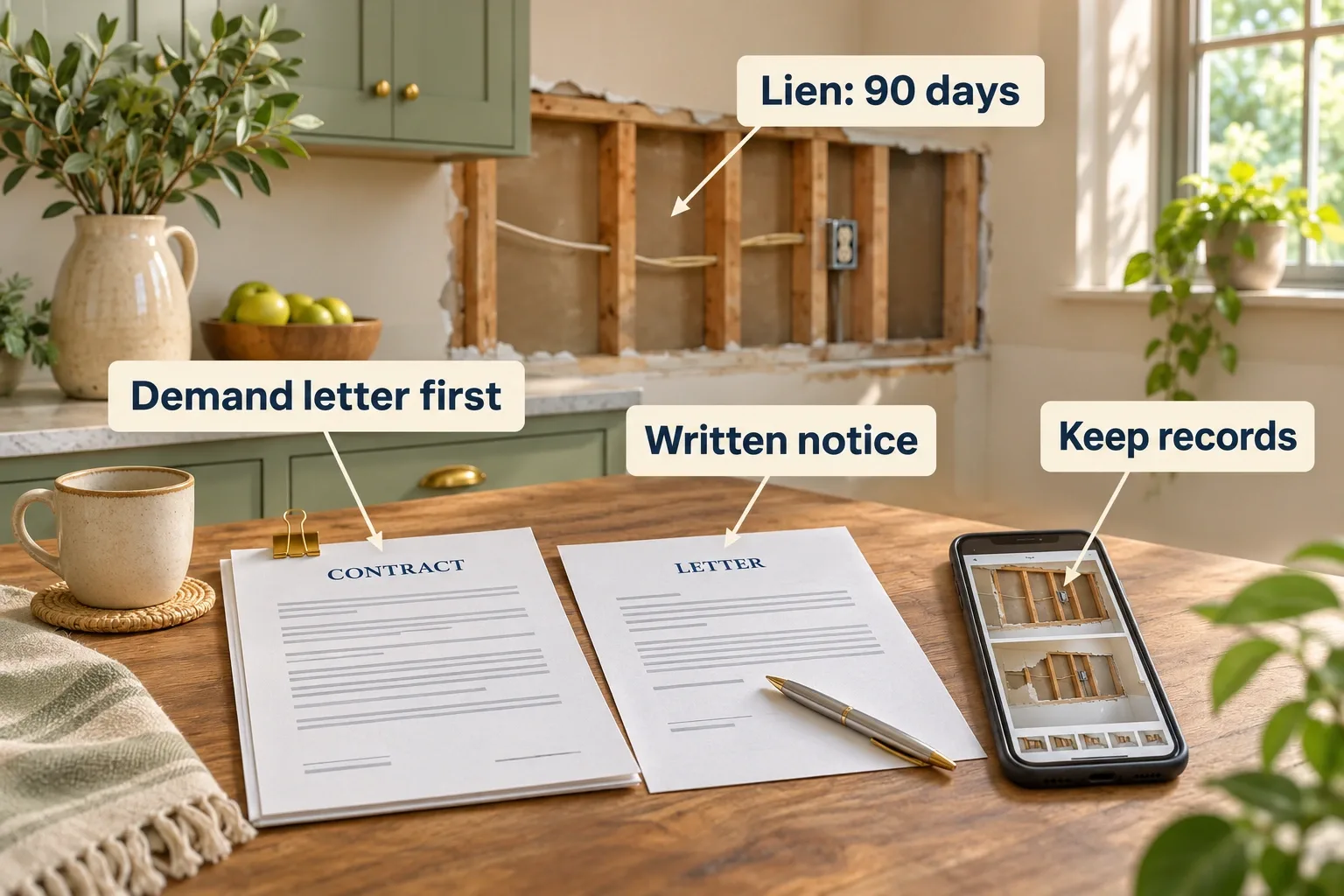
Washington has no special law for firing a home contractor: your written contract sets the rules. WashingtonLawHelp suggests first sending a demand letter that lists your complaints and gives a deadline, then trying mediation. If you end the contract, document the work done and the money paid. A contractor you hired directly can claim a lien for the amount due under the contract, but it must record the claim within 90 days after it stops work.
Before you fire: check these first
- Your contract. Look for a termination clause, a payment schedule and how changes are handled. That is what a court would read first.
- Registration. Look the business up at lni.wa.gov/verify. If it wasn't registered, RCW 18.27.080 generally bars it from suing you to collect for the work: see unregistered contractors.
- The disclosure statement. For a home job of $1,000 to under $60,000, the contractor must give you a "Notice to Customer" before work starts (RCW 18.27.114). WashingtonLawHelp says a contractor that didn't may lose the right to file a lien.
- Photos and records. Photograph the work, save texts and emails, and list every payment with dates.
Steps to end the job
- Send a demand letter. WashingtonLawHelp recommends a letter with a list of your complaints and what you need, with a deadline to respond. Keep it factual and calm, and ask for a specific action or amount.
- Try mediation. It is usually cheaper than court: see contractor mediation in King County.
- Give written notice. If nothing changes, end the contract in writing, follow any notice steps in your contract, and keep proof of delivery.
- Secure the site. Note what materials are on site and who owns them, and ask for keys or lockbox codes back.
Money, final payment and liens
| Who | Lien rule on an owner-occupied home remodel |
|---|---|
| The contractor you hired directly | No pre-notice needed; may claim a lien for the full amount due under its contract |
| Suppliers and lower-tier subs | Must send you a notice; can be paid only from what you hadn't yet paid the contractor when you got it |
| Deadline to record a lien | 90 days after the claimant stops work or deliveries; copy to you within 14 days |
| Deadline to sue on the lien | 8 months after recording |
- Don't pay ahead of the work. If the contractor owes you money back, put the amount in your demand letter.
- Ask for lien releases from the contractor and its suppliers before any final payment: see lien waivers.
- If a lien looks wrong, RCW 60.04.081 lets an owner ask superior court to release a frivolous lien or reduce a clearly excessive one.
After the contractor is gone
- Bond claim: a homeowner can sue on the contractor's bond within two years after the work was substantially completed or abandoned: see contractor bond claims.
- Smaller amounts: small claims court, up to $10,000.
- Report: L&I's Report-a-Fraud line is 1-888-811-5974. More: where to file a complaint.
- New contractor: check registration first and get a written contract: what the contract should include.
Frequently asked questions
Can I fire my contractor in Washington?
Yes, but your written contract sets the terms. WashingtonLawHelp suggests sending a demand letter with a deadline first, then mediation, and keeping records of the work and payments.
Do I have to pay a fired contractor?
That depends on your contract and the work done. A contractor you hired directly can claim a lien for the amount due under its contract if it records the claim within 90 days after it stops work.
Can a fired contractor put a lien on my house?
Possibly. It must record the lien within 90 days and send you a copy within 14 days. A contractor that didn't give you the required disclosure statement may lose its lien right.
What if the contractor walked off the job?
You can sue on its bond within two years after the work was abandoned, and you may be eligible for L&I's Homeowner Recovery Fund after a court judgment.
Should I send a letter before firing a contractor?
WashingtonLawHelp recommends a factual demand letter listing your complaints, what you want and a deadline to respond, sent before you sue.
Sources
- WashingtonLawHelp — Sue a construction contractor
- WashingtonLawHelp — Write a demand letter
- WashingtonLawHelp — Before you hire a contractor
- Chapter 60.04 RCW — Mechanics' and materialmen's liens
- RCW 18.27.114 — Disclosure statement
- L&I — Problems with a contractor
Sources accessed November 24, 2026.
This guide summarizes state law and agency information. It is not legal advice. See our disclosure and disclaimer.