Hired an unregistered contractor in Washington?
Your risks, their rights, and what to do
WHAT HAPPENS IF I HIRE AN UNREGISTERED CONTRACTOR IN WASHINGTON?
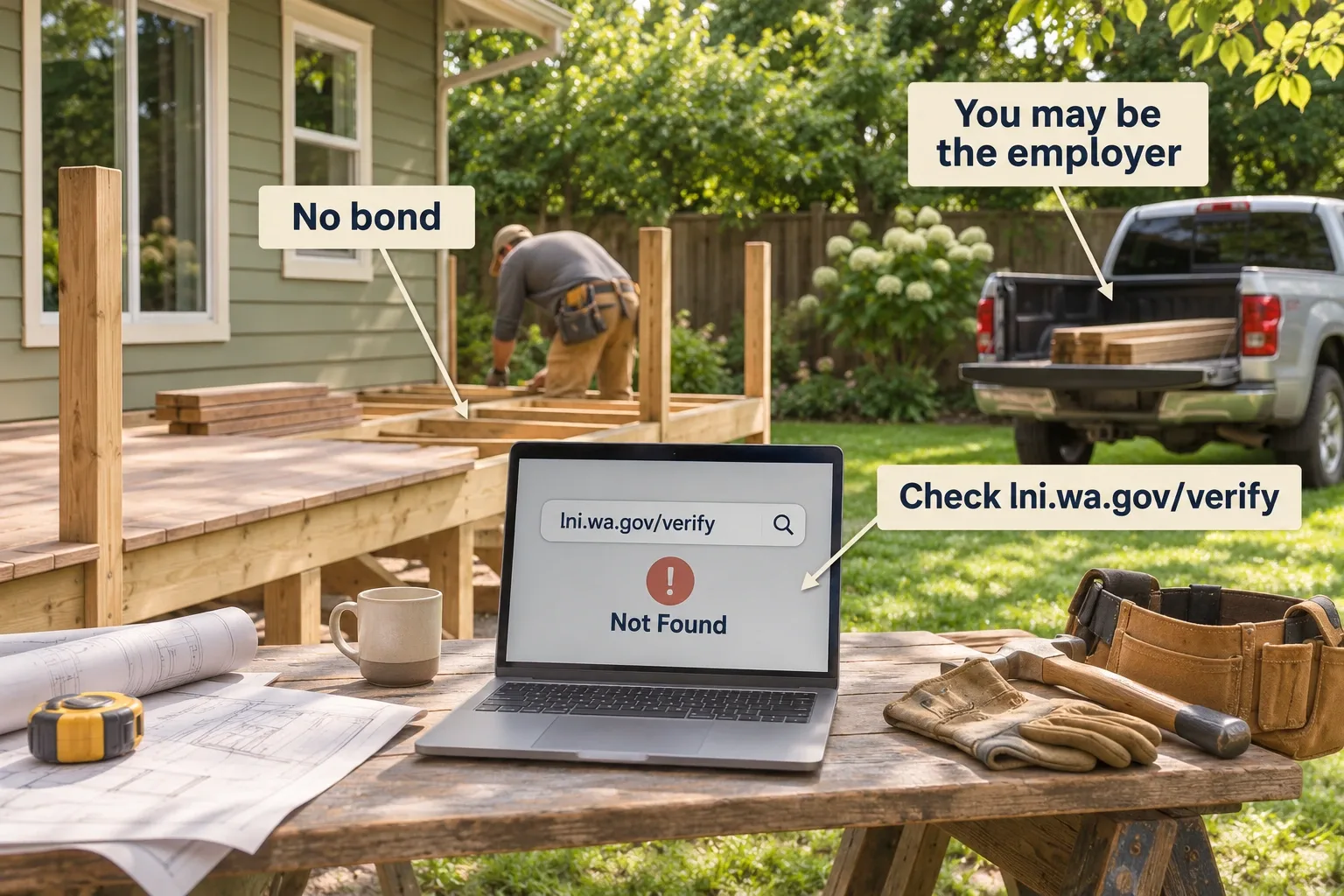
An unregistered contractor has no bond for you to claim, and L&I warns you may be considered the worker's employer, with duties for wages, taxes and workers' compensation, and may lose eligibility for the Homeowner Recovery Fund. On the other side, state law bars a contractor that wasn't registered from suing you to collect for the work. Expired, suspended or revoked registrations count as unregistered.
Registered vs. unregistered: at a glance
| Registered contractor | Unregistered contractor | |
|---|---|---|
| Bond you can claim | $30,000 general / $15,000 specialty | None |
| L&I Homeowner Recovery Fund | May be eligible | You may lose eligibility |
| Can sue you to collect for the work | Yes | Generally no (RCW 18.27.080) |
| Workers on your property | Employees covered through L&I | You could be considered the employer |
| Expired, suspended or revoked registration | — | Counts as unregistered |
Your risks
- No bond, no fund: registered contractors carry a $30,000 (general) or $15,000 (specialty) bond. An unregistered one has none, and L&I says you may lose possible eligibility for its Homeowner Recovery Fund.
- You may become the employer: L&I says you could be considered the worker's employer, with wage, tax, workers' comp, safety and record-keeping duties.
- Injuries: L&I warns that most homeowner policies don't cover workers, and without workers' comp you may be responsible for injury costs: contractor injuries and workers' comp.
- Liens: L&I says the property owner is ultimately responsible for making sure suppliers, subcontractors and workers are paid, or they can place a lien on the property: construction liens.
- Not a crime for you: an L&I safety directive says the homeowner isn't responsible for a contractor's violation of the registration law.
What the contractor can't do
- Sue you for payment: RCW 18.27.080 says a person acting as a contractor can't bring a court action to collect for work, or for breach of a contract that required registration, without alleging and proving it was registered when it bid or contracted. A Washington appeals court applied this in 2022.
- Advertise or bid: state law makes it illegal to advertise, bid or work as an unregistered contractor; it's a gross misdemeanor.
- Small-job exception: registration isn't required for casual work under $500 for labor and materials on one project, unless it's part of a larger job or the person advertises as a contractor (RCW 18.27.090).
What to do now
- Look the business up at lni.wa.gov/verify; an expired registration counts as unregistered.
- Stop advance payments and keep records: contract, texts, receipts, photos.
- Report it to L&I: online or at 1-888-811-5974.
- For money, consider small claims court (up to $10,000) or a lawyer for larger losses.
- Next time, check first: how to check a contractor in Washington.
Frequently asked questions
Can an unregistered contractor sue me for payment in Washington?
Generally no. RCW 18.27.080 requires a contractor to allege and prove it was registered before it can sue to collect for work or for breach of a contract that required registration.
Am I liable if I hire an unregistered contractor?
You aren't responsible for their registration violation, but L&I says you may be treated as the worker's employer and may be responsible for injury costs without workers' comp.
Can I claim the bond of an unregistered contractor?
No. Only registered contractors carry the bond. L&I says hiring an unregistered contractor may also cost you eligibility for the Homeowner Recovery Fund.
Does an expired registration count as unregistered?
Yes. State law defines an unregistered contractor to include one whose registration is expired, revoked or suspended.
Is there a dollar amount below which registration isn't needed?
Casual work under $500 on one project is exempt, unless it's part of a larger job or the person advertises as a contractor.
Sources
- RCW 18.27.080 — Registration prerequisite to suit
- RCW 18.27.090 — Exemptions and chapter 18.27 RCW (definitions)
- L&I — Hiring a contractor, remodeler or handyman (F625-084-000)
- L&I — DOSH Directive on homeowners
- WashingtonLawHelp — Before you hire a contractor
- Washington Court of Appeals — Dobson v. Archibald (2022)
Sources accessed November 20, 2026.
This guide summarizes state law and L&I information. It is not legal advice. See our disclosure and disclaimer.