Lien waivers and lien releases in Washington:
what to get before the final payment
WHAT LIEN RELEASE SHOULD I GET FROM MY CONTRACTOR IN WASHINGTON?
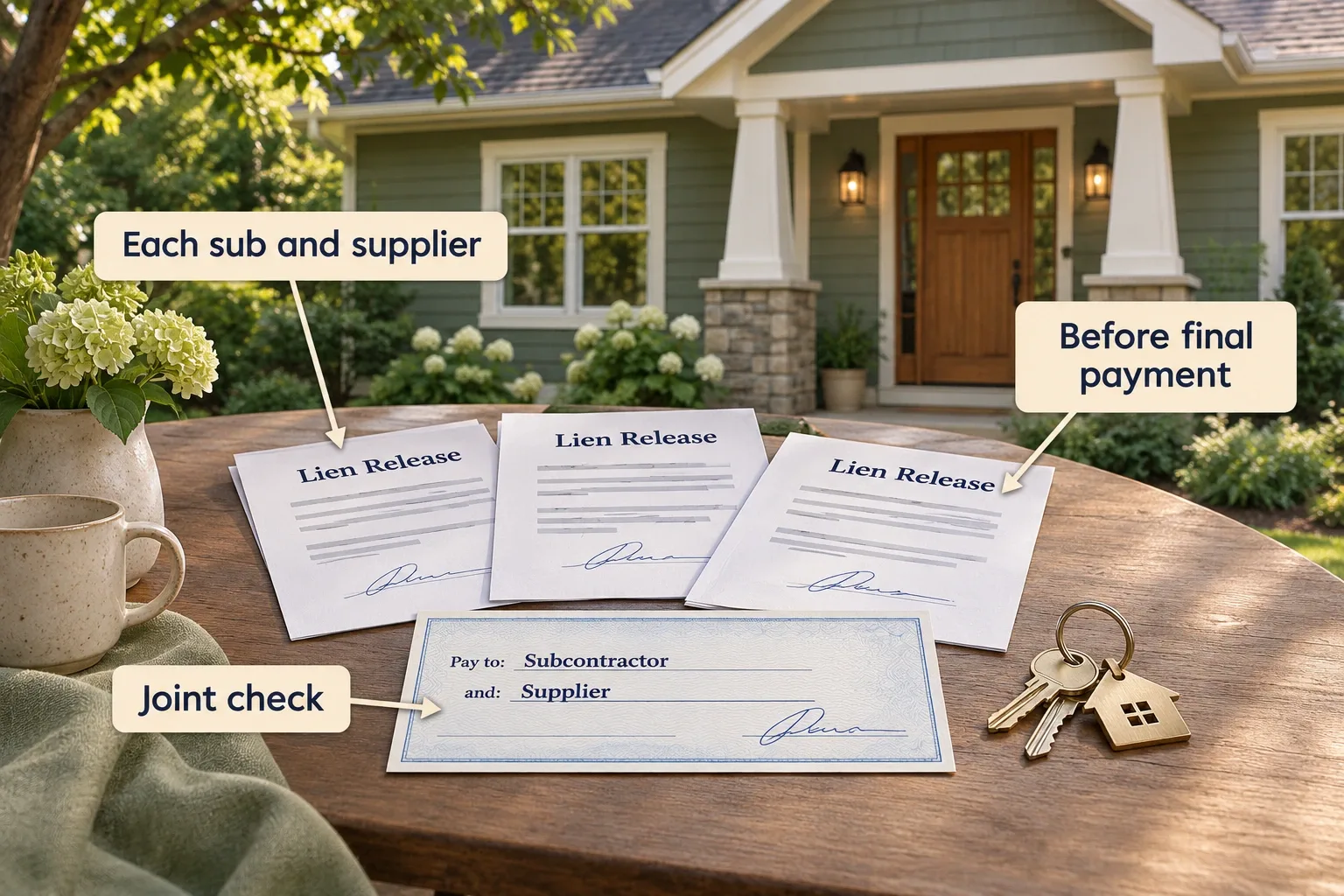
A lien waiver or release is a signed paper saying a contractor, subcontractor or supplier has been paid and gives up its lien rights for that work. L&I tells homeowners to get a signed lien release from all major contractors, subcontractors and suppliers before the final payment, and offers a sample "Waiver of Lien" form (F625-029-000). Under RCW 60.04.071, once a claimant is paid it must sign a release when you ask.
Why you need lien releases
- Paying twice. L&I warns that if a supplier, worker or sub isn't paid, a lien may be filed against your property and you could end up paying twice for the same work.
- Your contractor must tell you. The disclosure statement required for home jobs of $1,000 to under $60,000 says you may ask for lien releases (RCW 18.27.114). L&I says the contractor must give you more information about lien release documents if you request it.
- "You have final responsibility." L&I's lien fact sheet says the owner has final responsibility for seeing that all bills are paid.
How to collect releases, step by step
- Ask for the list. Before work starts, ask your contractor who its subs and major suppliers will be. On jobs over $5,000, the contractor must post a notice at the site that lists them (RCW 60.04.230).
- Keep every Notice to Owner. Anyone who sends one is a company you need a release from: see Notice to Owner.
- Pay with joint checks. L&I recommends checks payable jointly to the contractor and the sub or supplier.
- Collect signed releases on L&I's sample Waiver of Lien form or a similar document, one from each company, before the last payment.
- Consider escrow for a large job. L&I suggests asking whether the escrow agent protects you against liens when it pays out.
| Payment | What to collect |
|---|---|
| Progress payment | Release for work paid so far from the contractor; joint check if a Notice to Owner arrived |
| Final payment | Signed releases from the contractor and all major subs and suppliers |
| Retainage, if you held some back | Releases first, then release the retainage |
If a release is refused or a lien is filed
- Paid but no release? RCW 60.04.071 says the claimant must immediately sign a release of lien rights it has been paid for. If a court finds the delay unjustified, it can award costs, attorneys' fees and damages.
- Unpaid sub? L&I says to make a check payable to both the contractor and the lien claimant to get the lien removed.
- Recorded lien you dispute? You can bond it off or ask the court to release a frivolous lien: see construction liens.
- Ending the job early? See how to fire a contractor.
Frequently asked questions
What is a lien waiver?
A signed document in which a contractor, subcontractor or supplier confirms payment and gives up lien rights for that work. L&I offers a sample Waiver of Lien form, F625-029-000.
When should I ask for lien releases?
Before the final payment. L&I says to get signed releases from all major contractors, subcontractors and suppliers on your project.
Does my contractor have to give me lien releases?
The required disclosure statement says you may request them, and L&I says the contractor must explain lien release documents if you ask. Once a claimant is paid, it must sign a release on request.
What is a joint check?
A check payable to both your contractor and a subcontractor or supplier, so both must sign it. L&I recommends it to make sure subs and suppliers get paid.
What if a paid company won't sign a release?
Under RCW 60.04.071, a court that finds the delay unjustified can award costs, attorneys' fees and damages.
Sources
- L&I — What you should know about liens
- L&I — Facts about construction liens (F625-017-000)
- Chapter 60.04 RCW — Mechanics' and materialmen's liens
- RCW 18.27.114 — Disclosure statement
- WashingtonLawHelp — Before you hire a contractor
Sources accessed November 24, 2026.
This guide summarizes state law and L&I information. It is not legal advice. See our disclosure and disclaimer.