Got a "Notice to Owner" in Washington?
What it means and what to do
WHAT IS A NOTICE TO OWNER IN WASHINGTON?
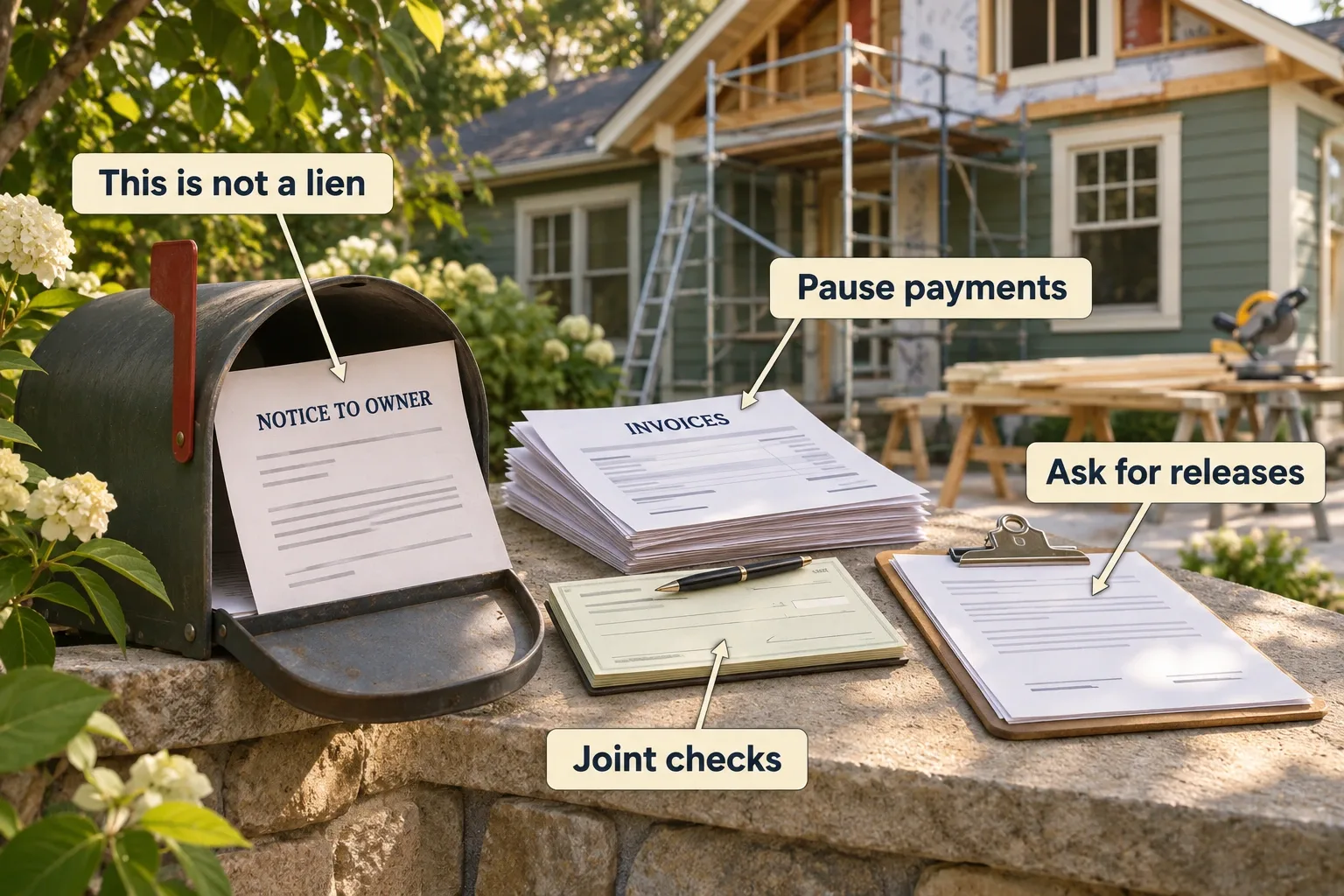
A "Notice to Owner" (notice of right to claim a lien) comes from a supplier or lower-tier subcontractor who wasn't hired by you. RCW 60.04.031 requires it before that company can enforce a lien. The form itself says "This is not a lien" and "Protect yourself from paying twice." On a remodel of a home you live in, such a claim can be paid only from money you hadn't yet paid your contractor when you received the notice. L&I says to stop further payments until you get lien releases.
Who sends a Notice to Owner
| Who | Must send a notice? |
|---|---|
| The contractor you hired directly | No |
| Subcontractor hired directly by your contractor | Usually no; on a home you live in, the notice rule in subsection (3) can apply |
| Material and equipment suppliers you didn't hire | Yes |
| Lower-tier subs and design professionals you didn't hire | Yes |
| Workers claiming only for their labor | No |
How much is at risk on a home you live in
- Only the unpaid balance. For repair, alteration or remodel of an owner-occupied single-family home, claims from those who didn't contract with you can be paid only from the amount you hadn't yet paid your prime contractor when you received the notice (RCW 60.04.031(3)(b)).
- When it counts as received: on personal delivery or receipt by certified or registered mail, or three days after mailing, not counting weekends and holidays.
- The form's advice: make checks payable jointly to your contractor and the company that sent the notice, or require lien releases from them.
What to do when you get one
- Don't ignore it. L&I says to tell your contractor you received it and ask how the sender will be paid.
- Pause payments. L&I says not to make further payments to your contractor until you get lien release documents from the sender.
- Pay by joint check. L&I recommends checks payable to both the contractor and the subcontractor or supplier.
- Get releases before the final payment from all major subs and suppliers: see lien waivers.
- Keep the notice with your contract and payment records.
If an actual lien is recorded
- Deadlines for the claimant: record within 90 days after it stopped work or deliveries, send you a copy within 14 days, and sue within 8 months (RCW 60.04.091 and 60.04.141).
- Hold back the amount: RCW 60.04.151 lets an owner withhold that amount from the prime contractor while the claim is pending.
- Bond it off: under RCW 60.04.161, recording a bond releases the property. For a claim of $10,000 or less, the bond is the greater of $5,000 or twice the claim; above that, 1.5 times the claim.
- Wrong lien: ask superior court to release a frivolous lien or reduce a clearly excessive one (RCW 60.04.081). More: construction liens in Washington.
Frequently asked questions
Is a Notice to Owner a lien?
No. The required form says "This is not a lien." It tells you who is supplying your project and that they could claim a lien if they aren't paid.
Can I end up paying twice?
That is the risk the notice warns about. On a remodel of a home you live in, claims from those you didn't hire are limited to what you hadn't yet paid your contractor when you got the notice.
Should I keep paying my contractor after a Notice to Owner?
L&I says not to make further payments until you get lien release documents from the sender, and to use joint checks.
Who doesn't need to send a Notice to Owner?
Anyone who contracted directly with you, workers claiming only for labor, and usually subcontractors hired directly by your prime contractor.
How long does a supplier have to file a lien?
It must record the lien within 90 days after it stopped furnishing materials or work, and send you a copy within 14 days.
Sources
- RCW 60.04.031 — Notices and exceptions
- Chapter 60.04 RCW — Mechanics' and materialmen's liens
- L&I — What you should know about liens
- L&I — Facts about construction liens (F625-017-000)
- L&I — Problems with a contractor
Sources accessed November 24, 2026.
This guide summarizes state law and L&I information. It is not legal advice. See our disclosure and disclaimer.