Roof storm damage insurance claim in Washington (2026):
steps, deadlines and your rights
DOES HOME INSURANCE COVER STORM DAMAGE TO A ROOF IN WASHINGTON?
Washington's Office of the Insurance Commissioner (OIC) says home insurance usually covers sudden damage but may not cover gradual leaks, and won't cover water damage if you delay repairs after a storm. Your insurer must acknowledge your claim within 10 business days and finish its investigation within 30 days unless it can't reasonably do so (WAC 284-30-360 and 284-30-370). You can choose your own contractor.
What home insurance usually covers on a roof
| Damage | Usually covered? |
|---|---|
| Sudden storm or accident damage to the roof | Usually yes, if you report it quickly and stop more water getting in |
| Water damage after a storm that you didn't repair promptly | No: OIC says insurance won't cover water damage if you delay repairs |
| Gradual leaks, such as water through cracks or gaps between building materials | Usually not |
| Mold or rot | Usually not, unless it comes from water damage your policy covers |
Roof insurance claim, step by step
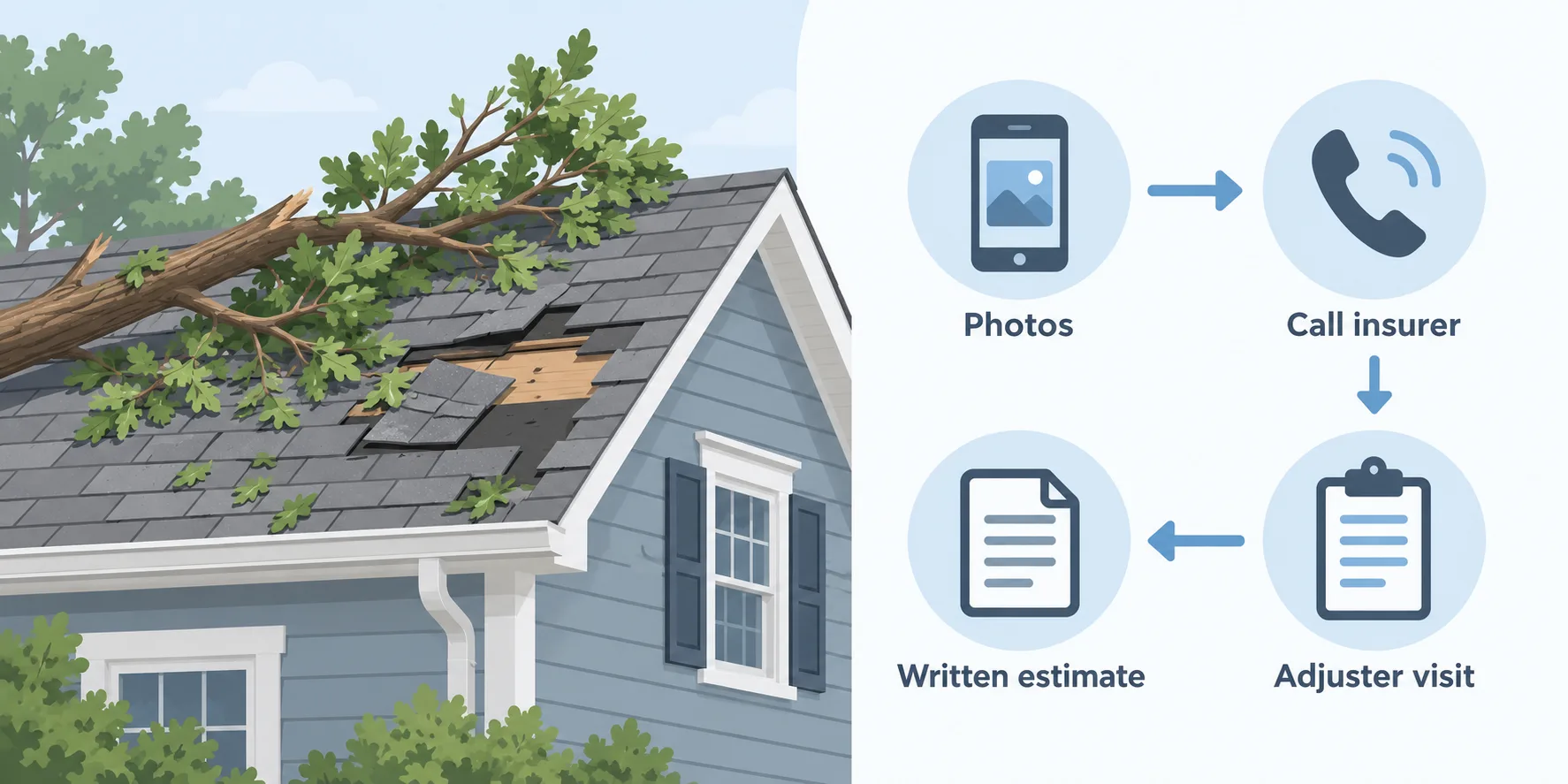
- Stop more damage. OIC says that if a storm damages your roof, you need to fix the damage quickly to stop more water from entering your home.
- Take photos and keep records. Be ready to provide receipts and photos to prove your loss, and keep copies of everything (OIC).
- Call your agent or insurer. Review your policy with them and ask what's covered. OIC says you can ask whether a loss is covered without filing a claim.
- Provide what they ask for, promptly. Ask what information they need to process the claim.
- Expect an inspection. OIC says your insurer isn't required to send an adjuster, but may send an adjuster, contractor or other professional, and has 30 days from the date you filed to inspect the damage.
- Get a written estimate from your own contractor. Compare it with the insurer's estimate line by line. Our guide on how to read a roofing estimate shows what each line means.
Deadlines your insurer must meet
| Step | Deadline | Rule |
|---|---|---|
| Acknowledge your claim | Within 10 business days of notice (individual policy) | WAC 284-30-360 |
| Complete the investigation | Within 30 calendar days of notice, unless it can't reasonably be done in that time | WAC 284-30-370 |
| If it needs more time | Written notice of why, then an update every 30 days | WAC 284-30-370 |
OIC also lists your right to a clear explanation of what's covered, timely payment and a claim decision, and an appraisal if you disagree with the amount of your loss. In Washington, your insurer can't depreciate labor costs when it calculates the actual cash value of a property claim (WAC 284-20-010).
Choosing your roofing contractor
- You choose. OIC says you have the right to select your own contractor. Your insurer may suggest contractors but isn't required to give you a list.
- Guarantees in writing. If you use a contractor your insurer chooses, OIC says the insurer should guarantee their work. Either way, get all guarantees in writing.
- Read before you sign an "assignment of benefit." OIC warns it could let the contractor negotiate and settle your claim directly with the insurer without your approval. Talk to your agent or insurer first.
- Upgrades may be on you. If the work goes beyond restoring your roof to its previous condition, OIC says you may have to pay the difference. Code-required upgrades may be covered by law and ordinance coverage, if your policy has it.
- Check the roofer. Look them up on L&I's Verify a Contractor tool. For jobs of $1,000 or more on a home, the contractor must give you a written disclosure statement before work starts (RCW 18.27.114).
- Public adjusters. You can work with the insurer's adjuster or hire a public adjuster, who works for you. OIC says to make sure they're licensed in Washington and to shop around, because rates vary.
Is a roof claim worth filing?
OIC says insurers generally consider your claims history when deciding whether to keep covering you or adjust your premium. If repairs cost only slightly more than your deductible, it suggests you may want to pay for the repair yourself.
| Job | Typical cost | Source |
|---|---|---|
| Roof repair, Seattle | $454–$2,655 (average $1,540) | Angi Seattle, Aug 2026 |
| Roof replacement, Seattle | $8,045–$17,399 (average $12,646) | Angi Seattle, Aug 2026 |
Compare these with your deductible. For details, see roof repair cost in Seattle and roof replacement cost in Seattle.
Frequently asked questions
Does home insurance cover storm damage to a roof in Washington?
Usually, if the damage is sudden. Washington's Insurance Commissioner says home insurance usually covers sudden damage but may not cover gradual leaks, and won't cover water damage if you delay repairs after a storm. Your policy decides.
How long does an insurer have to respond to a roof claim in Washington?
It must acknowledge the claim within 10 business days (WAC 284-30-360) and complete its investigation within 30 calendar days, unless that can't reasonably be done. From October 18, 2026, it must explain any delay in writing and update you every 30 days (WAC 284-30-370).
Can I choose my own roofer for an insurance claim?
Yes. The Insurance Commissioner says you have the right to select your own contractor, even if your insurer suggests others.
Should I sign an assignment of benefits with a roofer?
Be careful. The Insurance Commissioner warns it could let the contractor negotiate and settle the claim with your insurer without your approval. Talk to your agent or insurer before signing.
Does insurance cover an old roof that leaks?
Usually not. The Insurance Commissioner says home insurance usually doesn't cover gradual leaks, and usually doesn't cover mold or rot unless it comes from covered water damage.
Need a repair instead of a new roof? See roof repair cost by type of repair, or roof leak repair cost if water is already coming in.
Sources
- Washington Office of the Insurance Commissioner — Filing a homeowner insurance claim
- Washington Office of the Insurance Commissioner — Leaks, water damage and mold
- WAC 284-30-360 and WAC 284-30-370 (versions effective October 18, 2026)
- Angi — Roof repair cost in Seattle and roof replacement cost in Seattle (updated Aug 4, 2026)
- Washington Department of Revenue — Custom construction
- RCW 18.27.114 and L&I — Hiring a contractor
All sources accessed October 15, 2026.
This guide summarizes Washington consumer information and rules. It is not legal or insurance advice, and your policy's wording decides your claim. For help with an insurer, contact the Washington Office of the Insurance Commissioner. See our disclosure and disclaimer.