Door-to-door contractor scams in Washington:
storm chasers, "leftover asphalt" and how to check
HOW DO I SPOT A DOOR-TO-DOOR CONTRACTOR SCAM IN WASHINGTON?
L&I says most contracting scams involve people working without a valid registration. Common versions are crews offering "leftover" asphalt or roofing material, and storm chasers who arrive after wind storms. The Washington Attorney General warns against contractors who solicit door to door, pressure you to decide now, take only cash, want most of the money up front or won't give a written contract. If you sign at home, you may have three business days to cancel.
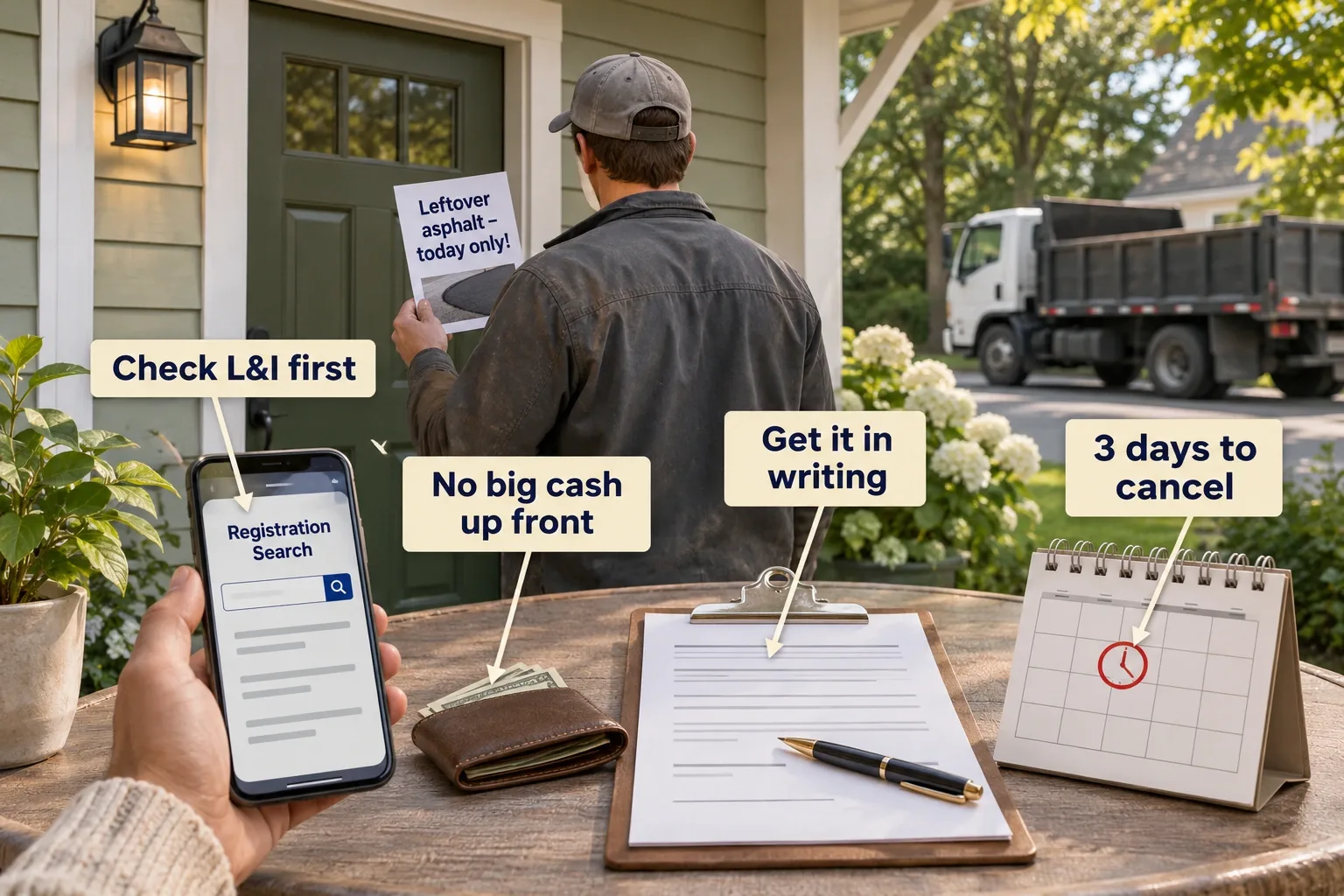
Common door-to-door scams
| Scam | How it works |
|---|---|
| Driveway paving | An uninvited crew claims leftover asphalt from a nearby job, offers a one-time deal, then raises the price after the work |
| Roofing | Similar pitch with leftover roofing; after payment the crew leaves without working or does poor work |
| Storm and disaster repair | Unregistered crews arrive after wind storms, floods or wildfires |
| Price creep | Money up front, then a demand for more once the job starts |
The Better Business Bureau told KOMO News that Washington consumers filed 106 contractor scam reports with BBB Scam Tracker over 12 months, with more than $1.3 million in reported losses.
Red flags the Attorney General lists
- Solicits door to door or pressures you for an immediate decision.
- Accepts only cash, or asks for all or most of the money up front.
- Offers a bid that is exceptionally low, or "too good to be true."
- Won't give a written contract, or gives credentials and references you can't verify.
- Suggests you borrow money from a lender to pay for the job.
A 5-minute check before you say yes
- Verify registration at lni.wa.gov/verify or 1-800-647-0982. Look for bond, insurance and past bond lawsuits: how to check.
- Get a written bid and compare it with other bids.
- Keep the deposit small and pay as work is finished: down payments.
- Read the cancellation notice. For a sale made at your home, the seller must give you two copies of a cancellation form: 3-day cancellation rules.
- Tree work after a storm? Check the city's permit rules first: tree removal permits.
If you already signed or paid
- Within three business days? Cancel in writing by certified mail if a 3-day rule applies.
- Card payment: ask your card company to dispute the charge.
- Report: L&I's Report-a-Fraud line, 1-888-811-5974; the Attorney General, 1-800-551-4636 or atg.wa.gov. More: where to file a complaint.
- Recover money: a registered contractor has a bond you can claim: bond claims. If it wasn't registered, see your options.
After a flood: FEMA and inspector impostors
Scams follow floods. FEMA and Washington Emergency Management list these facts to protect yourself:
- FEMA never charges for an inspection or for help with an application. FEMA and SBA will never ask you for money.
- Real FEMA inspectors carry an official laminated photo ID, already know your FEMA registration number, and never ask for bank information. A FEMA shirt or jacket is not proof of identity.
- FEMA does not hire or endorse contractors. Anyone who says they are "FEMA-approved" is not telling the truth.
- Washington Emergency Management advises using licensed local contractors with verified references, getting a written contract, and not paying more than half the cost up front.
- Report fraud to the Attorney General at atg.wa.gov/file-complaint or the FEMA Disaster Fraud Hotline at 866-720-5721.
Help that is real: FEMA, SBA and state aid after a flood.
Frequently asked questions
Are door-to-door contractors legal in Washington?
Door-to-door sales are legal, but the contractor must be registered with L&I. L&I says most contracting scams involve people working without a valid registration.
What is the leftover asphalt scam?
L&I describes uninvited crews claiming leftover asphalt from a nearby job, offering a one-time deal, then raising the price after the work, often with cheap materials.
Can I cancel a contract signed at my door?
Often yes. The FTC Cooling-Off Rule usually gives you until midnight of the third business day for sales of $25 or more made at your home, with exceptions such as emergencies.
Where do I report a contractor scam in Washington?
Call L&I's Report-a-Fraud line at 1-888-811-5974 or the Attorney General's consumer line at 1-800-551-4636.
How much should I pay up front?
The Attorney General warns against contractors who want all or most of the money up front. Keep the deposit small and pay as work is finished.
Sources
- L&I — Common contracting scams
- Washington Attorney General — Possible scams in the wake of floods
- Washington Attorney General — Storm cleanup and contractor red flags
- L&I — Problems with a contractor (Report-a-Fraud)
- FTC — Cooling-Off Rule
- KOMO News — BBB warns of storm chasers (secondary source)
- FEMA — Disaster fraud
- Washington Emergency Management Division — Be alert to fraud after storms and flooding
Sources accessed November 24, 2026.
This guide summarizes agency information. It is not legal advice. See our disclosure and disclaimer.