Contractor warranty in Washington:
how long you have and what to do about bad work
HOW LONG IS A CONTRACTOR'S WARRANTY IN WASHINGTON?
Washington has no general statutory warranty for a house remodel; a state House bill analysis notes that statutory warranties cover condominiums. Your protection comes mostly from the written contract and any product warranties. To sue over a written contract you generally have six years; for an oral one, three. A separate rule bars construction claims that don't arise within six years after the work is substantially completed. Before suing a contractor over a defect in your home, state law requires a written notice of claim at least 45 days ahead.
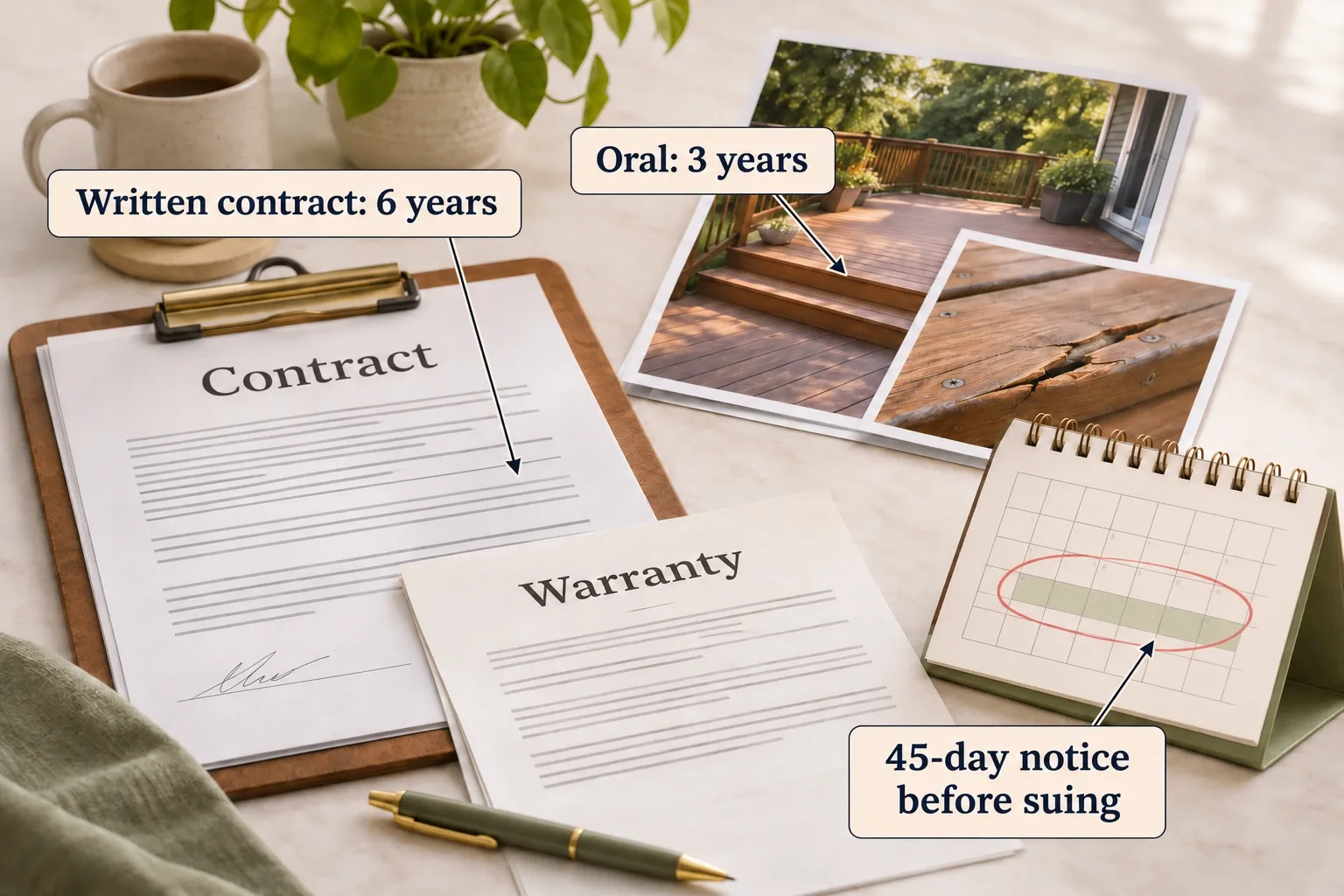
Time limits in Washington
| Rule | Time | Law |
|---|---|---|
| Claim on a written contract | 6 years | RCW 4.16.040 |
| Claim on an oral contract | 3 years | RCW 4.16.080 |
| Construction claims must arise within | 6 years after substantial completion (or end of services, if later) | RCW 4.16.310 |
| Contractor bond lawsuit | 2 years after the work is substantially completed or abandoned | RCW 18.27.040 |
| Notice of claim before suing over a home defect | at least 45 days before filing | RCW 64.50.020 |
Get the warranty in writing: an oral promise falls under the shorter three-year limit. How the bond works: contractor bond claims in Washington.
What a contractor warranty usually covers
- Workmanship: the contractor's own promise about its labor. Look for the length, what's excluded and how you report a problem.
- Products: the manufacturer's warranty on materials and equipment. Keep model numbers and registration cards; some products require registration.
- Limits to watch: clauses that shorten the time to sue, require arbitration or cap what the contractor will pay. Some of these clauses can be challenged, so ask a lawyer about yours before you rely on one.
Before you sign: what a Washington home improvement contract should include.
If the work is bad
- Document it: dated photos, the contract, invoices, change orders, texts and emails.
- Tell the contractor in writing and ask for a repair by a set date. Keep proof you sent it.
- Check the contractor with L&I's Verify tool for its bond, insurance and any other lawsuits: how to check a contractor in Washington.
- Hold the final payment until the defect is fixed, if your contract allows: paying a contractor in Washington.
- Job abandoned? See what to do when a contractor doesn't finish.
The 45-day notice before a lawsuit
- Notice: serve a written notice of claim on the contractor no later than 45 days before filing suit, describing the defect in reasonable detail.
- Contractor's answer: within 21 days after the notice (or 14 days after a meeting, if the contractor asks for one), the contractor must offer to inspect, offer money, or say it disputes the claim.
- Repair offer: if you allow an inspection, the contractor has 14 days afterward to offer to fix the defect at no cost, offer money, or decline.
- If it says no or doesn't answer, you may sue without further notice.
- Your contract should tell you. State law requires contractors to give homeowners a conspicuous notice of this right to offer a cure when they sign a contract for a substantial remodel. A revised version of that section takes effect January 1, 2028.
Smaller claims: small claims court against a contractor.
Frequently asked questions
How long is a contractor warranty in Washington?
There's no general statutory warranty for a remodel. Its length is whatever your contract and the product warranties say, within legal time limits such as six years for a written contract.
How long do I have to sue a contractor in Washington?
Generally six years on a written contract and three years on an oral one. Construction claims must also arise within six years after the work is substantially completed.
Do I have to warn the contractor before I sue?
For a defect in your home, yes. RCW 64.50.020 requires a written notice of claim at least 45 days before you file.
Can I claim the contractor's bond for bad work?
Yes, through a superior court lawsuit filed within two years of substantial completion or abandonment. Bonds are $30,000 for general and $15,000 for specialty contractors.
Is a verbal warranty valid?
It can be, but it's hard to prove, and claims on oral contracts generally have a three-year limit instead of six. Get it in writing.
Sources
- RCW 4.16.040 — Actions limited to six years and RCW 4.16.080 — three years
- RCW 4.16.310 — Construction claims, accrual and limitations
- RCW 64.50.020 — Construction defect action, notice of claim and RCW 64.50.050 — Notice to homeowner
- RCW 18.27.040 — Contractor bond
- Washington House bill analysis, HB 1045 (2009): warranties in residential construction
- L&I — Hire smart, step by step
Sources accessed November 20, 2026.
This guide summarizes state law. It is not legal advice. See our disclosure and disclaimer.