Contractor bond vs. insurance in Washington:
what each one actually protects
WHAT IS THE DIFFERENCE BETWEEN A CONTRACTOR BOND AND INSURANCE IN WASHINGTON?
A registered Washington contractor needs three things: a surety bond ($30,000 general, $15,000 specialty), general liability insurance ($250,000 combined, or $200,000 public liability plus $50,000 property damage), and workers' comp through L&I if it has employees. The bond is mainly for unfinished or poor work under your contract and is claimed through a lawsuit. Liability insurance covers damage the work causes to people or property. Workers' comp covers the contractor's injured employees.
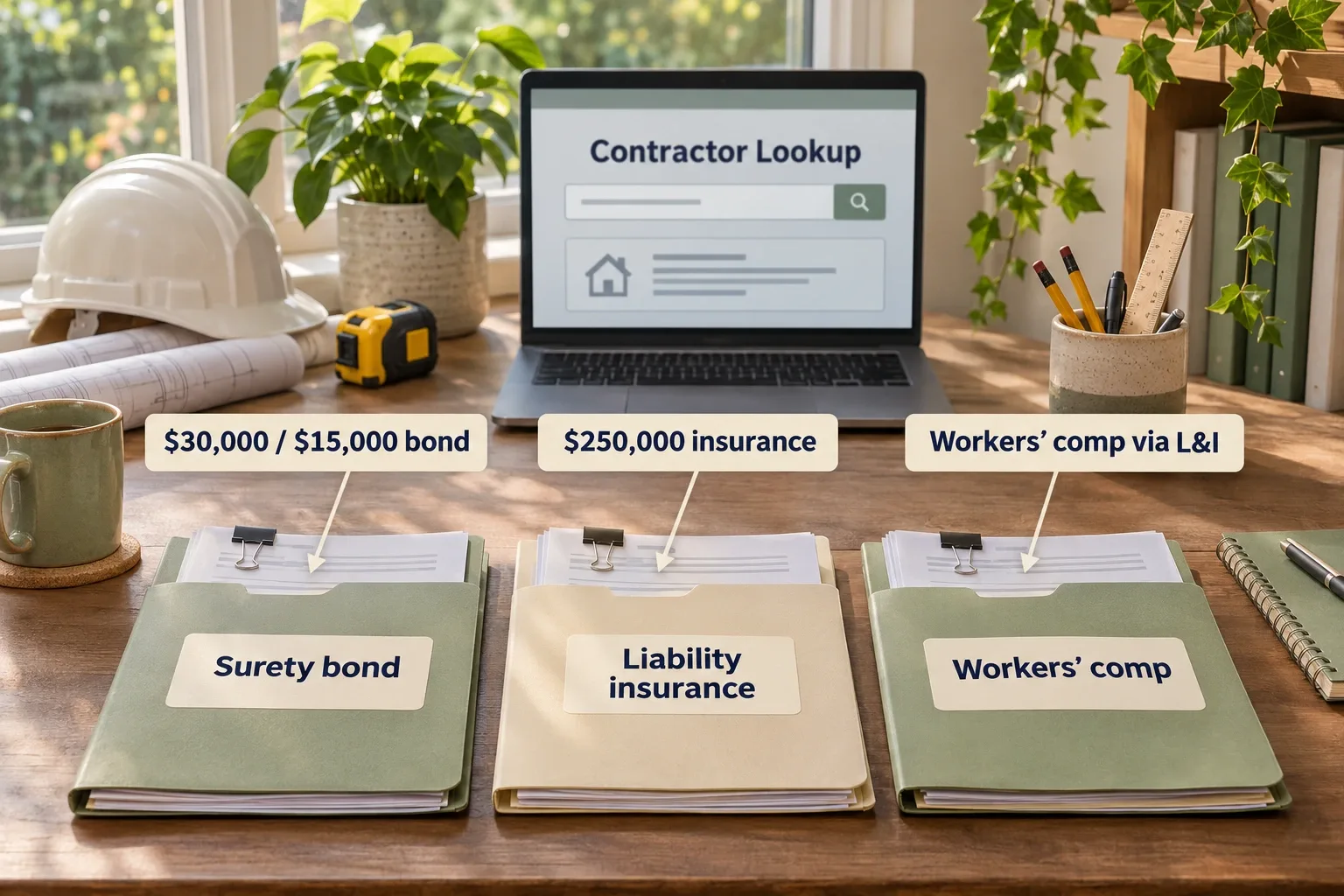
Bond, insurance and workers' comp side by side
| Surety bond | Liability insurance | Workers' comp | |
|---|---|---|---|
| Required amount | $30,000 general / $15,000 specialty | $250,000 combined, or $200,000 + $50,000 | Through L&I if the contractor has employees |
| Protects you from | Unfinished or poor work, breach of contract | Damage the work causes to people or property | Injury costs for the contractor's workers |
| How you claim | Lawsuit in superior court; L&I serves the bond company | Claim with the insurer | The worker files with L&I |
| Time limit for homeowners | 2 years after work completed or abandoned | Set by the policy and general law | — |
The limits you should know
- The bond is small and shared. Other claims against the same contractor can use it up. The disclosure statement warns the bond might not be enough to cover a claim on your contract. Extra help: L&I's Homeowner Recovery Fund, up to $25,000 after a court judgment.
- A bond claim costs money. L&I puts the court filing fee at about $200, plus a $66.20 L&I processing fee: see bond claims.
- Insurance can lapse. RCW 18.27.050 automatically suspends a contractor's registration when its policy expires or is canceled.
- Unregistered means none of it. No bond on file, no required insurance: see unregistered contractors.
- A performance bond is extra. L&I says you can ask a contractor to post a performance bond for the whole project cost before it starts.
How to check a contractor's bond and insurance
- Search the business at lni.wa.gov/verify. L&I says it shows the registration, bond, liability insurance and workers' comp status.
- Write down the bond company, bond number, insurer and expiration dates.
- Ask for a certificate of liability insurance for your file.
- Check again before the last payment, since registrations can be suspended. Full checklist: how to check a contractor.
What to do after damage: contractor damaged your property. Injured workers: workers' comp and homeowners.
Frequently asked questions
Is a contractor bond the same as insurance?
No. In Washington, the bond is mainly for claims over unfinished or poor work under your contract, while liability insurance covers damage the work causes to people or property.
How much is a contractor bond in Washington?
$30,000 for a general contractor and $15,000 for a specialty contractor.
How much liability insurance must a Washington contractor carry?
A $250,000 combined single limit, or $200,000 public liability and $50,000 property damage, with L&I listed as certificate holder.
How do I claim a contractor's bond?
File a lawsuit in superior court naming the bond company, and send copies with a $66.20 fee to L&I, which serves the contractor and the bond company. Homeowners have two years.
Does insured mean the contractor is good?
No. L&I says checking online shows the contractor has posted a minimum bond and bought liability insurance, not the quality of its work. Check references too.
Sources
- L&I — Register as a contractor
- L&I — Problems with a contractor
- L&I — Filing a lawsuit against a contractor
- RCW 18.27.050 — Insurance or financial responsibility
- L&I — What you should know about liens (performance bond)
- L&I — Protect my home
- RCW 18.27.114 — Disclosure statement
- L&I — Homeowner Recovery Fund
Sources accessed November 24, 2026.
This guide summarizes state law and L&I information. It is not legal or insurance advice. See our disclosure and disclaimer.