Who is responsible for the side sewer in Seattle?
Owner vs. city, permits and shared lines
WHO PAYS TO FIX A SIDE SEWER IN SEATTLE?
Seattle Public Utilities says the entire side sewer, all the way to the connection with the public sewer main, is owned and maintained by the property owner. That usually includes the part under the sidewalk and street. The city is responsible for the public main itself. Repairs need a side sewer permit from SPU: $280 for a sanitary repair in 2026, with one to two inspections included.
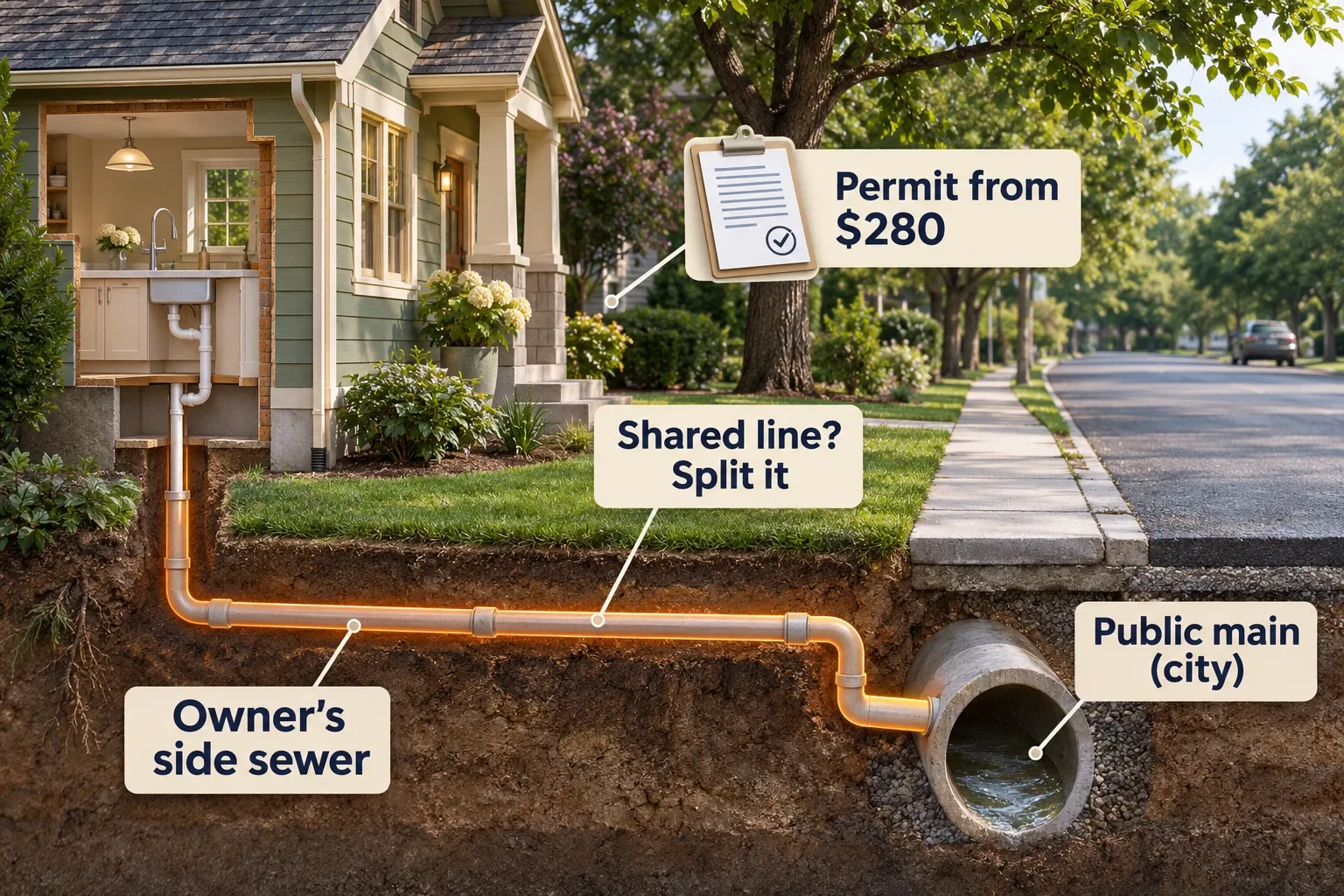
Who owns what
| Part of the system | Responsible |
|---|---|
| Plumbing inside the house | Owner; permits from Public Health – Seattle & King County |
| Side sewer outside the building, to the main | Owner |
| The public sewer main | Seattle Public Utilities |
| A side sewer shared by two or more homes | The owners together |
SDCI defines the side sewer as all piping outside the building footprint, up to but not including the connection to the public main. Not sure where the line runs? SPU's side sewer program can help you check responsibility, find your side sewer on city maps, and review a scope video of the connection.
Side sewer repair permit and fees (SPU, 2026)
| Permit | Fee |
|---|---|
| Sanitary side sewer repair | $280 |
| Drainage side sewer repair | $375 |
| Addition or alteration | $375 |
- When you need it: SPU requires a repair permit when a pipe or an outside fixture, such as a clean-out or yard drain, is repaired or replaced.
- Speed: SPU says repair permits are usually processed by the end of the next business day, and a routine repair needs no site plan.
- Testing: new pipe longer than 10 feet must be pressure tested.
- Cost of the work itself is separate: see sewer line replacement cost and sewer camera inspection in Seattle.
Shared side sewers
- Shared cost. SPU says owners share responsibility for the parts of a side sewer they share. Repairs need coordination with your neighbor.
- Recorded agreements. Some shared lines have a recorded Joint Use and Maintenance Agreement that sets access rights and who maintains what. Check your title records.
- Disagreement? Talk first, then consider mediation in King County.
What to do if your sewer backs up
- Download your side sewer card from SDCI's website to see where the line runs.
- Have the line scoped by a camera to find the problem.
- If the damage looks like it's at the connection to the main, email SideSewerRequests@seattle.gov to ask SPU to review the video.
- Hire a registered contractor and make sure the SPU permit is issued before digging: who pulls the permit.
- Check whether your homeowners policy or a home warranty covers any part of it: home warranties in Washington.
Insurance for backups: sewer backup coverage and backwater valves.
Frequently asked questions
Is the city responsible for my sewer line in Seattle?
Only for the public main. SPU says the entire side sewer, up to the connection with the public main, is owned and maintained by the property owner.
Do I need a permit to repair my side sewer in Seattle?
Yes. SPU requires a side sewer repair permit when a pipe or outside fixture is repaired or replaced. A sanitary repair permit is $280 in 2026.
Who pays for a shared side sewer?
SPU says owners share responsibility for the shared portions. A recorded joint use agreement may spell out the details.
Who is responsible for the sewer under the street?
Your side sewer runs to the connection with the public main, so the pipe under the street up to that connection is generally yours. Ask SPU to confirm if the damage is at the connection.
How fast can I get a side sewer repair permit?
SPU says repair permits are typically processed by the end of the next business day.
Sources
- Seattle Public Utilities — Side sewer permits
- Seattle SDCI — Side sewer permit
- Seattle Public Utilities — Your side sewer
- SPU — Side sewer documents, definitions and resources
- SPU — Taking care of your sewer pipe
Sources accessed November 25, 2026.
This guide summarizes city information. It is not legal advice. See our disclosure and disclaimer.